

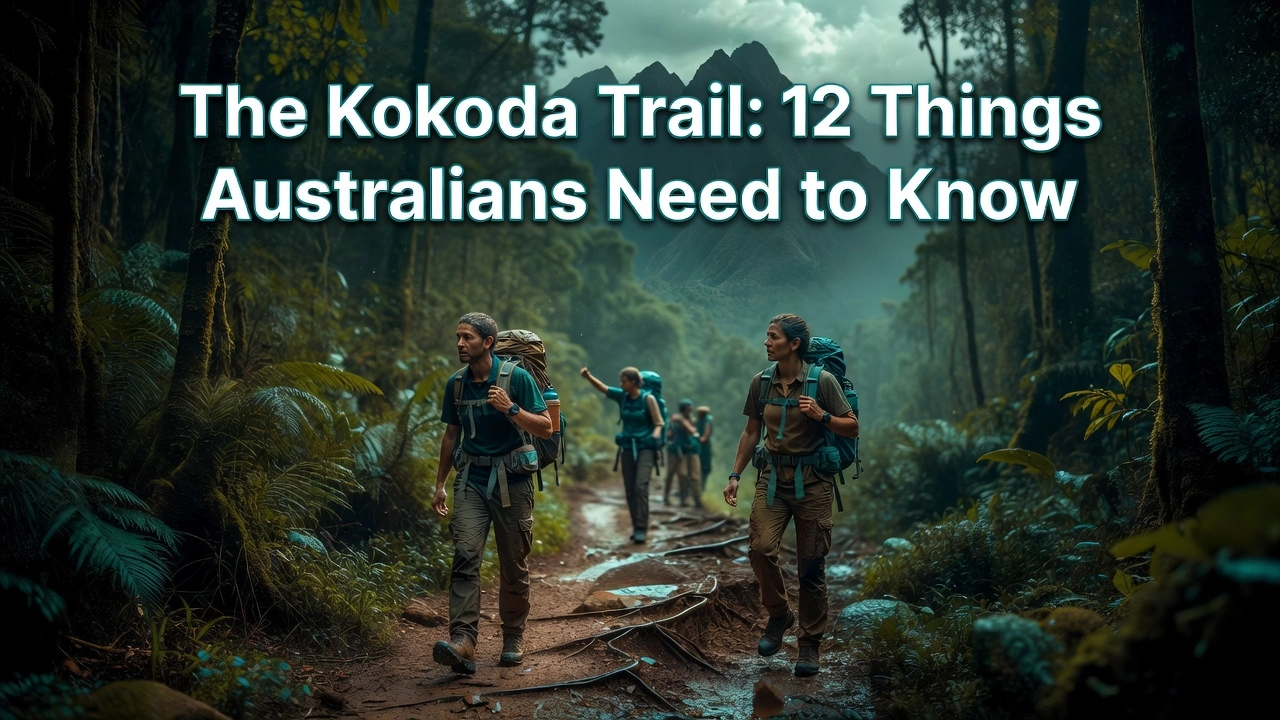
Few journeys carry the weight of history quite like the Kokoda Trail. Stretching roughly 96 kilometres through the unforgiving Owen Stanley Range in Papua New Guinea, this iconic track was the site of one of Australia’s most defining military campaigns during World War II. Young Australian soldiers, many of them barely out of their teens, battled not only Japanese forces but also brutal terrain, tropical disease, and relentless rain to defend their nation from invasion.
Today, the Kokoda Trail draws thousands of trekkers each year, particularly Australians seeking to connect with this powerful piece of national heritage. But walking in the footsteps of the “Fuzzy Wuzzy Angels” and the original Diggers requires serious preparation, cultural awareness, and historical understanding.
Whether you’re planning to tackle the track yourself or simply want to deepen your knowledge of its significance, this guide covers 12 essential things every Australian should know before setting foot on, or forming an opinion about, this legendary trail. From physical demands to cultural protocols, we’ve got you covered.
What Is the Kokoda Trail?
The Kokoda Trail, also widely known as the Kokoda Track, is a 96 km single-file footpath that cuts through the Owen Stanley Range in Papua New Guinea. The route connects Owers’ Corner, situated near Port Moresby in the south, to the historic village of Kokoda in the country’s north. While the straight-line distance measures roughly 60 km, the trail twists relentlessly through steep mountain terrain, meaning every kilometre demands significantly more time, energy, and physical resolve than that number suggests.
The terrain is genuinely unlike anything found on the Australian mainland. Trekkers navigate dense tropical jungle, razor-sharp ridgelines, fast-flowing river crossings, and punishing valley descents, all within a hot and intensely humid environment. Rainfall can transform already challenging ground into thick mud within minutes, and temperatures swing dramatically between sweltering jungle valleys and bitterly cold highland nights near the trail’s highest point, Mount Bellamy, which sits at roughly 2,190 metres above sea level.
What makes the Kokoda Trail particularly demanding is its remoteness. There is no road access along the route, mobile coverage is extremely limited, and trekkers rely on satellite communications for emergencies. For the full duration of the walk, you are genuinely isolated within one of the world’s most rugged landscapes. According to PNG Tourism, most trekkers complete the trail over 8 to 12 days, covering 10 to 15 kilometres daily through conditions that test even experienced hikers.
The History You Cannot Ignore
To walk the Kokoda Trail is to walk through one of the most consequential chapters of Australian military history. In 1942, Japanese forces landed near Gona and Buna on 21 July and rapidly pushed south along the track toward Port Moresby, bringing them within striking distance of Australia’s northern defences. Vastly outnumbered Australian troops, many from the 39th Battalion, conducted desperate delaying actions across sites including Isurava, Eora Creek, Templeton’s Crossing, and Brigade Hill before holding firm at Imita Ridge, just 48 kilometres from Port Moresby. The subsequent Australian counteroffensive recaptured Kokoda on 2 November 1942, halting the Japanese advance and marking a decisive turning point in the Pacific theatre of the Second World War.
The human cost was staggering. According to the National Museum of Australia, more than 600 Australian soldiers were killed and around 1,000 were wounded during the broader Kokoda campaign, with approximately 900 Japanese deaths in the Kokoda fighting alone. Disease, malnutrition, and extreme exhaustion compounded combat losses on both sides, making this one of the most physically and psychologically punishing campaigns any Australian soldier has ever endured.
Central to the Australian survival was the indispensable contribution of the Papuan carriers, known affectionately as the “Fuzzy Wuzzy Angels.” Thousands of Papuan men carried supplies, ammunition, and critically, wounded soldiers on stretchers through terrain that defied any mechanical alternative. Without their logistical support and intimate knowledge of the jungle, the Australian position would have been untenable. Their role sits at the heart of the campaign’s legacy and is recognised at sites along the trail today, as documented by the Australian War Memorial.
Walking the trail now means moving directly through this history. Trekkers pass named battle sites, village memorials, and stretches of overgrown jungle where war relics still occasionally surface beneath the roots and soil. Named locations such as Isurava and Brigade Hill carry the weight of specific engagements, transforming each day’s walking into an act of remembrance rather than simple recreation.
This historical depth connects directly to ANZAC values of resilience, sacrifice, and mateship, giving the Kokoda Trail a cultural significance for Australians that few other treks on earth can match. It is precisely why ANZAC Day departures in mid-April are consistently among the most sought-after bookings, with trekkers completing dawn services at memorials along the route and reflecting on what was fought for and won in these same mountains more than eight decades ago.
How Hard Is the Kokoda Trail, Really?
The numbers alone tell a sobering story. One trekker who completed the Kokoda Trail over 9 days recorded approximately 38,162 feet (11,632 metres) of combined elevation gain and loss across 52 miles of jungle track. That figure is not a single dramatic climb followed by a long descent; it is the result of constant, relentless undulation where the trail rises sharply by 300 metres, drops immediately, and repeats the cycle for day after consecutive day. There are virtually no flat sections where legs can recover while still moving forward. Your muscles are either driving uphill or absorbing the impact of a steep descent for almost the entire duration of the trek.
Daily walking time typically sits between 6 and 10 hours, and on harder days it can exceed that. Average daily distances of 10 to 14 kilometres sound manageable on paper, but jungle terrain covered in mud, exposed roots, and constant gradient changes cuts your effective pace roughly in half compared to flat trail walking. Crucially, you cannot simply push harder to make up time. The terrain demands focus, balance, and careful foot placement at every step, meaning fatigue compounds technical risk rather than just slowing your speed.
Humidity in the Owen Stanley Range introduces a physiological dimension that surprises even experienced hikers. Relative humidity regularly sits between 77 and 90 percent, which severely limits your body’s ability to cool itself through sweat evaporation. Heart rate climbs higher for the same output, perceived exertion increases substantially, and overnight recovery is far less complete than on a dry mountain trail. Guides frequently describe the experience as a stairmaster inside a sauna, and that comparison is not an exaggeration.
Beyond fitness and humidity, the trail demands genuine technical competence. River crossings, muddy ridge descents, and exposed sections require ankle stability, sound balance, and mental composure that cardiovascular conditioning alone cannot provide. Strong cardio is a necessary foundation, but without specific preparation for uneven and unstable terrain, it is insufficient.
Experienced trekkers, specialist operators, and the Kokoda Track Authority are consistent on one point: do not underestimate this trail regardless of your prior hiking resume. Trekkers with Everest Base Camp or alpine multi-day experience have been humbled by Kokoda. It is widely rated among the world’s most demanding multi-day treks, and that reputation is entirely earned.
How Long Does the Kokoda Trek Take?
Highly trained ultra-endurance athletes can technically complete the full 96 km in as few as 3 to 4 days, with the fastest recorded time sitting at an extraordinary 16 hours 34 minutes. But these feats exist firmly outside the realm of typical trekking. For the overwhelming majority of participants, guided itineraries are structured across 8 to 11 days on the trail, averaging roughly 12 km per day with 6 to 10 hours of active hiking. This pacing exists for good reason: it allows time for genuine acclimatisation, village stays, and meaningful engagement with the battlefields and memorials that give the trail its deepest significance.
Compressing the itinerary carries real consequences. Shorter timelines eliminate recovery windows between gruelling ascents, significantly increasing the risk of injury, exhaustion, and illness, particularly for trekkers who haven’t conditioned their bodies specifically for sustained tropical jungle terrain. The cumulative physical toll of repeated steep descents on muddy, root-tangled tracks accelerates rapidly without adequate rest.
Several variables shape pace beyond fitness alone. Group size, shifting weather in the Owen Stanleys, and the level of historical engagement a trekker wants all play a substantial role. Conditions can change quickly, turning straightforward sections into cautious, time-consuming crossings. Those considering their options can review structured Kokoda itinerary formats to understand how reputable operators balance daily distance with recovery.
Many operators deliberately build rest afternoons into camp schedules at key village stops. This structure serves dual purposes: supporting physical recovery while creating space for cultural immersion, shared meals with local communities, and quiet reflection at historical sites. Kokoda rewards those who resist the urge to rush it.
When Is the Best Time to Trek the Kokoda Trail?
PNG’s dry season runs roughly from April to November, and this window represents the primary trekking season for the overwhelming majority of licensed operators. Conditions during this period are as favourable as the Owen Stanley Range ever gets: lower overall rainfall, more manageable trail surfaces, easier river crossings, and cooler overnight temperatures at elevation. That said, the jungle environment means afternoon showers remain common even in the driest months, so no departure is entirely free of rain. Within this window, May through September tends to offer the most reliably settled conditions, with June through August particularly popular during Australian school holidays.
ANZAC Day departures anchored around 25 April are consistently the most sought-after slots on the calendar. The emotional weight of completing a dawn service at a battlefield site like Isurava while standing on the actual ground where Australians fought in 1942 draws significant demand every year. Several 2026 ANZAC-period departures are already at or near capacity, which is not unusual given that these slots routinely sell out months in advance.
The wet season, running December through March, presents an entirely different proposition. Heavy rainfall swells rivers to dangerous levels, transforms the trail surface into deep mud, and substantially increases evacuation risk. Most licensed operators simply do not run scheduled departures during this core period, and those conditions largely explain why.
Booking lead times for quality guided treks typically run 6 to 12 months, and for ANZAC-period or school holiday windows, earlier is always safer. Treat early planning as a requirement, not a preference.
Do You Need a Guide for the Kokoda Trail?
Technically, independent trekking on the Kokoda Trail is possible, but in practice it is far more regulated than many assume. All trekkers must arrange their trek through a licensed operator registered with the Kokoda Track Authority (KTA), a Papua New Guinea Special Purpose Authority that governs the entire track. The KTA issues Commercial Operations Licences to approved operators, regulates guide and porter standards, collects permit fees, and enforces environmental and safety requirements. Permits, which cost around K350 for international trekkers, directly fund track maintenance, landowner payments, and community development along the route. In short, there is no casual, self-guided option here.
The overwhelming majority of trekkers choose fully supported guided operators, and the reasons are practical rather than optional. Navigation through dense jungle across a 96 km route with unmarked branch trails, river crossings, and rapidly changing weather is genuinely complex. Medical evacuation from a remote environment with no roads and limited communications infrastructure is a serious logistical challenge. Beyond safety, choosing a licensed operator directly supports Papuan communities; porters and local guides represent primary income sources for villages along the track, with the Kokoda Track Operators Association enforcing regulated weight limits and fair employment standards.
What to Expect from Pricing and Operators
Fully supported guided treks from reputable Australian-based operators typically range from AUD 4,500 to 6,500 or more per person. These packages generally cover KTA permits, licensed guides and porters, village accommodation, most meals, and in-country transfers. Getaway Trekking offers 11-day licensed treks from approximately AUD 4,495, while Australian Kokoda Tours lists 10-day options from around AUD 4,995 to 5,799 depending on departure city. Key operators in the Australian market include World Expeditions, Discover Kokoda, Getaway Trekking, Australian Kokoda Tours, and Kokoda Spirit, each offering variations in itinerary direction, historical interpretation, and group composition.
When evaluating operators, treat the following as non-negotiable quality signals: current KTA licensing compliance, transparent porter welfare policies including weight limits and fair pay practices, experienced Australian and PNG guide partnerships with remote first aid certification, and clearly documented emergency evacuation protocols backed by adequate public liability insurance. Membership in the Kokoda Track Operators Association provides an additional layer of accountability. Asking direct questions about these standards before booking will quickly separate reputable operators from those cutting corners.
What Physical Preparation Actually Looks Like
The gap between wanting to complete the Kokoda Trail and being genuinely ready for it is wider than most trekkers initially appreciate. For an average-fitness Australian, a realistic preparation window sits between 6 and 12 months of structured, progressive training. This is not a program you can compress into six weeks. The body needs sustained time to adapt to the specific demands of consecutive high-output days, carrying load over sustained elevation change, and recovering overnight to do it all again. Short, intense preparation blocks may build some cardiovascular fitness, but they leave critical gaps in tendon and joint resilience, pack tolerance, and the deep aerobic base that Kokoda genuinely requires.
Train for the Terrain, Not Just the Distance
The most transferable training modalities are stair climbing with a weighted pack, hilly trail hiking with progressive load, and back-to-back long days where cumulative fatigue becomes part of the training stimulus itself. Victorians preparing for Kokoda are genuinely well-positioned. The Dandenong Ranges offer steep, fern-lined terrain ideal for repeated elevation sessions. The Grampians and the Alpine region provide longer multi-day routes where real trail conditions, variable underfoot surfaces, and sustained ascents replicate what PNG demands. Training on these trails with a loaded pack across consecutive days builds the specific adaptation that flat gym work simply cannot replicate.
Heat Acclimatisation Is Non-Negotiable
PNG’s tropical humidity consistently catches Australian trekkers off guard, even those who arrive in good physical condition. Integrating deliberate heat exposure into your preparation, through sauna sessions, hot weather training days, or high-intensity effort in warm conditions, triggers meaningful cardiovascular adaptations including improved sweating efficiency and plasma volume expansion. These physiological changes reduce the strain PNG’s climate places on the body and make early trail days significantly more manageable.
Build Mental Endurance Alongside Physical Fitness
Eight to eleven consecutive demanding days in a remote jungle environment creates psychological pressure that fitness alone does not resolve. Cumulative fatigue, variable weather, remote isolation, and the emotional weight of walking significant historical ground all compound over time. Progressive back-to-back training days, deliberate exposure to discomfort, and developing personal pacing strategies are all ways to build the mental resilience that separates trekkers who complete Kokoda comfortably from those who simply survive it.
For those building toward PNG, Take Shape Adventures’ guided Victorian day hikes and multi-day retreats provide a structured, supported environment to develop elevation endurance, practise with pack load, and build genuine outdoor confidence progressively, making each training milestone meaningful preparation rather than guesswork.
Hydration and Nutrition on the Track
Feeding and hydrating your body correctly on the Kokoda Trail is not a secondary consideration; it is a direct determinant of whether you finish in good shape or grind to a halt somewhere in the Owen Stanley Range.
Jungle humidity fundamentally changes your hydration equation. Unlike dry mountain environments or even most Australian trail conditions, the tropical rainforest along the Kokoda Trail impairs sweat evaporation. Your body still perspires heavily to regulate temperature, but that sweat cannot evaporate efficiently, leaving you losing fluid rapidly while your thirst cues fail to keep pace. Trekkers consistently report needing 3 to 4 litres of fluid per day at minimum, with higher intake required on longer or more exposed sections. If you are calibrating your intake against Victorian bushwalking experience, you will fall behind before day two.
Electrolytes are non-negotiable at this intensity. Sustained perspiration in tropical conditions strips sodium, potassium, and magnesium from your system at a rate that plain water simply cannot address. The consequences are predictable: muscle cramping, energy crashes, headaches, and reduced cognitive function at exactly the moments when clear thinking matters most. Medical literature has specifically documented risks of exercise-associated hyponatremia on the track when trekkers drink high volumes of plain water without matching electrolyte replacement. Carry electrolyte tablets or powder and use them daily, not reactively when cramps have already set in. Practise this protocol during your training phase so your gut is accustomed to it.
Village nutrition covers your energy base but not your recovery needs. Meals provided in villages along the trail centre on rice, sweet potato (kaukau), and other root vegetables, which deliver a reliable carbohydrate supply for daily energy demands. What they typically lack is sufficient protein to support muscular repair overnight. Over 8 to 11 consecutive days of high-load trekking, that protein deficit compounds. Supplement with nuts, protein bars, or lightweight shelf-stable options packed in your kit to close that gap.
Treat all water before drinking, without exception. Rivers and streams on the trail appear clean but carry genuine contamination risk. Guided operators generally manage purification for their groups, but equipment can fail and situations change. Carry your own treatment capacity regardless, whether purification tablets, a SteriPEN, or a portable filter. This applies equally to supported and independent trekkers.
The Take Shape Adventures blog has explored the science behind hiking hydration in detail, including why electrolytes matter and how to approach fluid periodisation across long days on the trail. Those principles translate directly to what the Kokoda Trail demands of your body.
Why Kokoda Is Becoming a Wellness Pilgrimage
Something fundamental is shifting in how people talk about completing the Kokoda Trail. Where earlier generations of trekkers framed the experience almost exclusively around physical endurance and historical homage, a growing community now reaches for a different vocabulary entirely: resilience, clarity, grief processing, perspective reset, and emotional renewal. This is not incidental language. It mirrors the core lexicon of contemporary wellness travel, and it signals that Kokoda has evolved into something far more layered than a demanding jungle walk.
The conditions that produce these shifts are genuinely rare. The combination of sustained physical suffering, the weight of WWII historical gravity, authentic cultural encounters with Koiari and Orokaiva communities, and the raw beauty of remote jungle terrain creates a psychological environment that few other experiences can replicate. Critically, the absence of digital connectivity across 8 to 11 days removes the constant fragmentation that typically prevents deep introspection. Shorter wellness retreats and weekend getaways rarely achieve the same depth, simply because the duration and immersion are insufficient. Kokoda strips that away entirely and holds you in it.
Operators have taken clear notice. Themed departures now routinely centre on mental health awareness, veteran healing and transition, charity fundraising, and personal development, with organisations partnering on dedicated Kokoda treks designed explicitly around resilience-building and emotional growth. The motivational profile of today’s Kokoda trekker has shifted well beyond proving physical toughness, and the industry is responding accordingly.
This evolution maps closely onto the philosophy that underpins Take Shape Adventures’ approach to outdoor experiences, combining movement, curiosity, challenge, and nature-based wellbeing as genuine drivers of personal growth. The alignment is direct, even though the Kokoda Trail sits outside Take Shape’s current geographic offering.
For trekkers returning from an experience of that magnitude, the integration period matters enormously. Journalling, continued movement, mindfulness practice, and structured reflection in the weeks following a transformative adventure are where insights consolidate into lasting change. Take Shape’s yoga, hiking, and wellness retreat programming provides a practical and evidence-informed framework for exactly this kind of post-trek integration, helping returning trekkers sustain the clarity they found on the track long after they are home.
Current Track Conditions and Challenges
The Kokoda Trail’s current state deserves honest attention from anyone planning a trek. In April 2024, ABC News published an investigation describing the track as being in its worst condition in more than 30 years, highlighting sharp tourism decline, infrastructure degradation, and deep logistical pressures across the sector in Papua New Guinea. Annual trekker numbers, which peaked at approximately 5,600 in 2008, had already fallen considerably through the 2010s and continued declining further into the mid-2020s. Local communities depending on campsite fees and porter wages felt the impact directly, and management coordination between government bodies, landowners, and operators remained a persistent challenge.
The risk profile in 2026 is meaningfully different from a decade ago. Track blockades, including disruptions near Nauro village in both 2023 and 2024, have interrupted seasons, stranded groups, and caused real financial harm to communities along the route. Infrastructure deterioration compounds these access issues. Booking with a licensed, Kokoda Track Authority (KTA)-compliant operator carrying strong local relationships is not simply advisable; it is the most important logistical decision you will make. Licensed operators carry obligations around porter welfare, safety protocols, and community benefit agreements. Unlicensed operations offer none of these protections and can be stopped by rangers mid-trek.
Before committing to any departure, verify current track conditions, permit requirements, and your chosen operator’s active licensing status directly with the KTA. Conditions shift seasonally, and political or infrastructure events can alter access rapidly and without much public notice.
That said, experienced and well-supported operations continue running successful treks throughout the dry season. The trail’s history, its landscapes, its villages, and the human encounters with guides and porters remain profoundly intact for those who complete it with proper preparation and the right team behind them.
Australian Kokoda Alternatives Worth Knowing About
Not everyone can get to Papua New Guinea this year, and that is not a reason to pause your preparation. Australia offers a genuinely compelling set of training grounds and challenge events that mirror Kokoda’s demands far more closely than most trekkers realise.
1. The Kokoda Challenge Events
The annual Kokoda Challenge events, held across Brisbane, the Sunshine Coast, and the Gold Coast, are the most structured domestic simulation available. Distances range from 18 km through to 48 km, with a flagship 96 km option on the Gold Coast that matches the original track’s length and accumulates over 4,000 metres of vertical elevation. These are team-based events emphasising endurance, mateship, and sustained effort across fire trails, creek crossings, and bush summits. Over 8,300 participants took part across 2025 events, reflecting serious growth in demand. For anyone building toward PNG, completing a Kokoda Challenge event is one of the most honest readiness tests available domestically.
2. The 1000 Steps, Ferntree Gully
For Victorians, the 1000 Steps at the Kokoda Track Memorial Walk in Ferntree Gully sits at the intersection of training value and historical meaning. The steep ascent through Dandenong Ranges rainforest closely replicates jungle trail conditions, while memorial plaques honouring Australian soldiers create a direct connection to the original campaign. It is Melbourne’s most-used bushwalk for good reason, and repeated sessions build the leg-strength and cardiovascular base that Kokoda’s terrain demands.
3. Multi-Day Victorian Routes
The Grampians Peaks Trail, the Falls to Hotham Alpine Crossing, and the Great Ocean Walk collectively develop the back-to-back elevation endurance, pack tolerance, and navigational confidence that the PNG track requires. These are not approximations; they are serious multi-day commitments with genuine cumulative fatigue and varied terrain.
4. Structured Support Through Take Shape Adventures
Take Shape Adventures offers guided Victorian day hikes and multi-day retreats across many of these exact landscapes, providing structured progression, expert leadership, and a community of like-minded adventurers. That combination of support and challenge progressively builds real outdoor capability.
A season of progressive Australian hiking is not a fallback position. It is the evidence-based foundation that makes a future Kokoda attempt safer, richer, and genuinely achievable.
Is the Kokoda Trail Right for You?
Having absorbed everything covered so far, the most important question remains the most personal one: is the Kokoda Trail genuinely the right challenge for you right now?
Your fitness baseline is the first honest filter. If you are not currently completing regular 6-hour hikes on hilly terrain while carrying a loaded pack, you have not yet reached the minimum floor for a safe and enjoyable experience on the track. This is not a discouragement; it is simply the reality the terrain demands. A structured 6 to 12 month preparation program is the responsible answer for most Australians, not a shortcut around it.
Budget deserves equal honesty. Fully supported guided treks are priced at approximately AUD 4,500 to 6,500 or more per person. Once you add return flights to Port Moresby, comprehensive travel insurance with helicopter evacuation cover, gear purchases, vaccinations, and permits, the total cost of a responsible Kokoda trip realistically sits at AUD 7,000 to 9,000 or higher. Understanding this figure upfront helps you plan seriously rather than be caught short mid-commitment.
Your motivation will shape your entire experience. Trekkers driven by genuine historical connection, personal transformation, or fundraising purposes consistently report far deeper satisfaction than those chasing status or ticking a box. The hardship is the same for everyone; what differs is the meaning you carry through it.
Timeline realism is non-negotiable. Needing 10 to 14 days away from work and family, booking 6 to 12 months in advance, and committing to a serious training program makes Kokoda a life decision, not an impulsive booking.
If your honest answer is not yet, treat that as a starting point. Building toward Kokoda through progressive Australian adventure experiences is one of the most rewarding athletic and personal growth journeys available, with the trail waiting at the end for those who prepare properly.
Start Where You Are and Build Toward It
The Kokoda Trail ultimately rewards those who earn it. Every piece of evidence, from operator reports to trekker accounts, points to the same conclusion: the quality of physical and mental preparation in the months beforehand is the single most consistent predictor of a meaningful, safe, and successful experience on the track.
For Australians who feel the pull of Kokoda but know they are not yet ready, the answer is not to wait passively. It is to build systematically, starting with the trails and challenges accessible right now. Progressive adventure closer to home, done consistently and with intention, transforms Kokoda from an aspirational idea into a realistic, well-founded next step.
Take Shape Adventures’ guided Victorian hikes, multi-day retreats, and adventure community offer exactly this kind of structured, supported pathway. Building back-to-back elevation days, trail confidence, and group accountability through local experiences creates the foundation that makes harder objectives genuinely achievable.
Four actions to take today:
- Verify current track conditions and permit requirements directly with the Kokoda Track Authority before committing to any booking
- Select a licensed operator with clear, transparent policies on porter welfare and safety protocols
- Begin a 6 to 12 month training program anchored around progressive elevation, pack-loaded hikes, and consecutive long days
- Join a structured adventure community to maintain accountability and motivation through every stage of preparation